
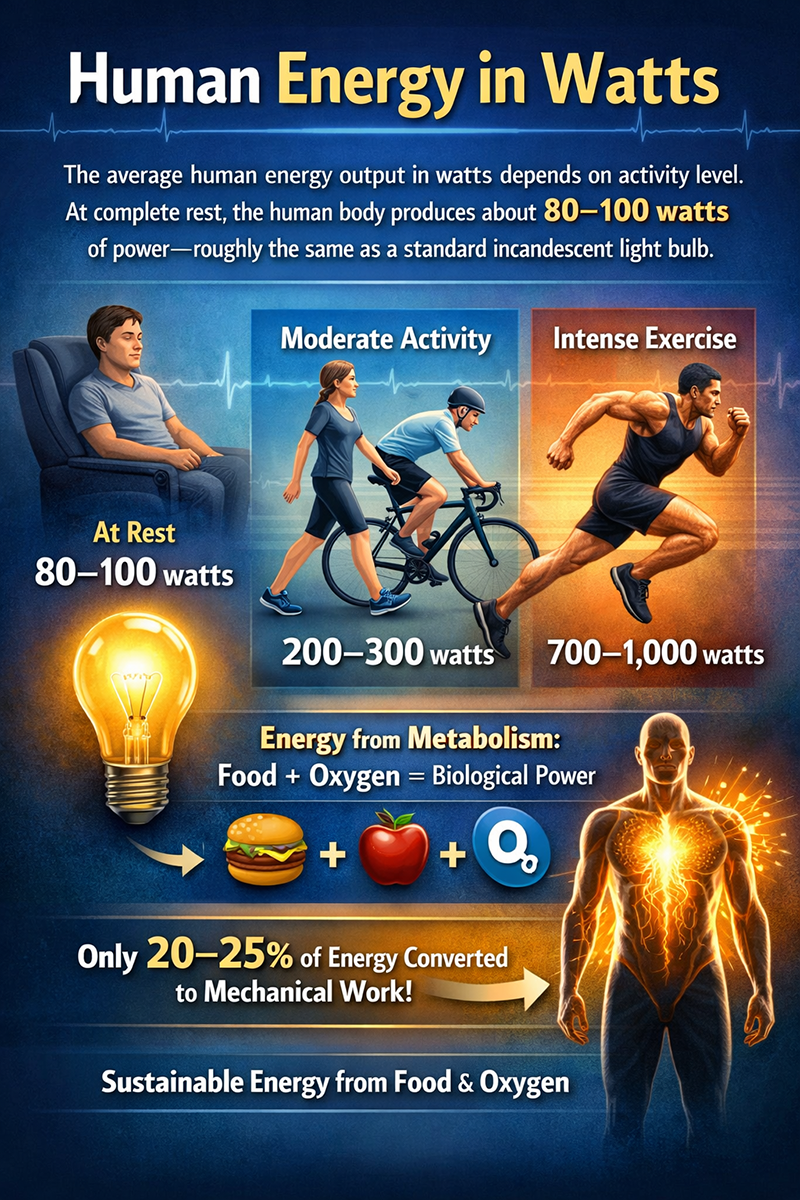
The average human energy output in watts depends on activity level. At complete rest, the human body produces about 80–100 watts of power. Roughly the same as a standard incandescent light bulb. This energy comes from metabolism, where food is converted into usable biological energy to keep the heart beating, lungs breathing, brain functioning, and body temperature stable. During moderate activities like walking, power output can rise to 200–300 watts, while intense physical effort such as sprinting or cycling can briefly exceed 700–1,000 watts in trained individuals. Even though humans are not highly efficient mechanical machines (only about 20–25% of metabolic energy converts to mechanical work), our continuous energy production makes us remarkably sustainable biological systems powered simply by food and oxygen.