
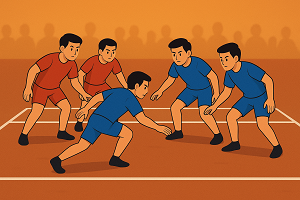
Kabaddi is the national sport of Bangladesh and the state sport of several Indian states like Punjab, Tamil Nadu, and Maharashtra.
Kabaddi has a long and rich history, believed to be over 4,000 years old, with roots in ancient India. Here’s an overview of its evolution:
Origins:
Ancient India: Kabaddi is thought to have originated as a way for villagers to develop physical strength and agility. It was also used for self-defense and military training.
Mythological Link: Some believe kabaddi was played during the time of the Mahabharata. A famous reference is Abhimanyu’s attempt to break into the chakravyuha formation — similar to a raider entering the opponent’s territory alone.
Traditional Forms:
Kabaddi existed in many forms across regions, such as:
Chedugudu (Andhra Pradesh)
Hu-tu-tu (Maharashtra)
Sadugudu (Tamil Nadu)
Kaunbada (Karnataka)
These regional versions eventually merged into the modern form we know today.
Modern Era:
1920s: Standard rules began to be codified in India.
1938: Kabaddi was demonstrated at the Indian National Games in Kolkata.
1950s: It gained structure with the formation of state associations and formal competitions.
1951: Included in the Asian Games as a demonstration sport.
1990: Became an official medal sport in the Asian Games in Beijing.
International Expansion:
The International Kabaddi Federation (IKF) was formed in 2004.
The Pro Kabaddi League (PKL), launched in 2014 in India, helped boost global popularity.
Countries like Iran, South Korea, Bangladesh, Kenya, and others now have competitive teams.